For parents · For students
BSc or MChem/MSci in Chemistry: How the Routes Differ
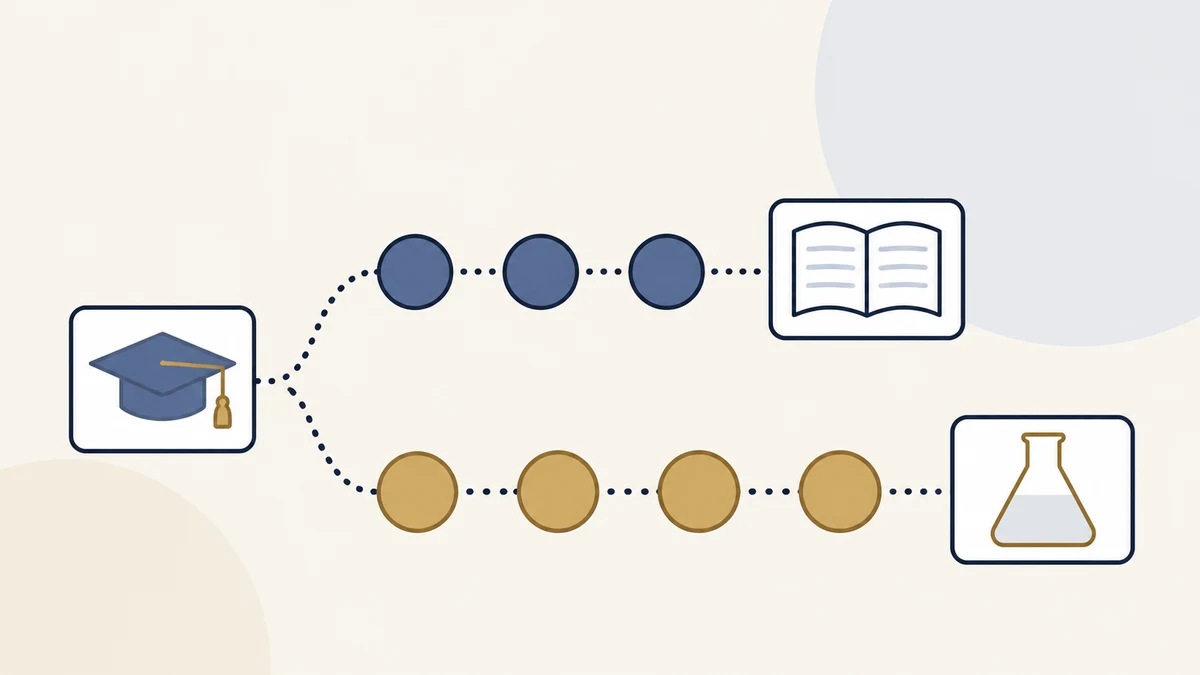
UK universities commonly offer chemistry as a three-year Bachelor of Science (BSc) and as a longer integrated master’s degree, usually titled MChem or MSci. The early years at the same university are often shared, but the awards differ in length, academic level and professional recognition. A four-year course is not automatically the more suitable choice. This article sets out how official frameworks, professional accreditation and named university pages describe the two routes. Chemical engineering typically uses different titles (BEng and MEng) and is noted briefly at the end, not treated as the same decision.
Two awards, not two names for the same course
A BSc with honours is a bachelor’s degree at Level 6 of the Frameworks for Higher Education Qualifications (FHEQ) in England, Wales and Northern Ireland. An integrated master’s is a Level 7 qualification. The Quality Assurance Agency (QAA) states that these courses typically include study equivalent to at least four full-time academic years in England, Wales and Northern Ireland, and five in Scotland, of which at least one full-time academic year is at Level 7, and that they are designed to meet the Level 6 and Level 7 descriptors in full.[1]
The Royal Society of Chemistry (RSC) describes MChem and MSci as having the same status as each other; the titles are simply used at different universities. In general, the additional year contains more advanced material than a BSc at the same institution. The first two years are usually identical to the BSc, after which the routes diverge in year 3 or 4.[2][3]
The integrated master’s is a single undergraduate programme leading to one award at master’s level. The RSC states that there is normally no intermediate bachelor’s award, and King’s College London makes the same point for its MSci and MEng degrees: students do not receive both a BSc and an MSci.[3][4] That is different from taking a BSc and then applying separately for a standalone master’s such as an MSc.
UCAS describes an integrated master’s as a course in which students who successfully complete the bachelor’s part of the studies progress into the master’s without reapplying.[5] Universities still set their own progression requirements. At King’s, progression from year 3 to year 4 of MSci and MEng programmes typically requires an overall honours average of at least 55% at the end of the third year; a student who does not meet that threshold can still graduate, but is moved to the equivalent BSc or BEng.[4] That figure is an example from one institution, not a national rule.
In Scotland, a BSc with honours is typically longer than the three-year English pattern, and an integrated master’s is typically five years.[1][14] A year in industry or a year abroad can extend either route, so the official course page for the intended year of entry should be checked for length and structure.
Accreditation and Chartered Chemist
The RSC accredits bachelor’s degrees (BSc) and integrated master’s degrees (MChem and MSci), as well as some postgraduate taught master’s (MSc). Accreditation is a peer-reviewed judgement against stated requirements for knowledge, practical work, project work, assessment and transferable skills. The RSC’s student guide gives a figure of 300 hours’ practical work for a BSc and 400 hours for an MChem or MSci. An accredited master’s degree fulfils the academic requirements for Chartered Chemist (CChem) status; an accredited bachelor’s degree partially fulfils those requirements.[3][6] That is not a claim that an accredited BSc is an inadequate degree, or that every chemist must hold CChem. It describes the academic component of a professional award that also requires later professional experience.
Named examples follow the same pattern. At the University of York, the three-year BSc Chemistry (F100) is RSC-accredited and described as partially fulfilling the academic requirements for CChem, and the four-year MChem Chemistry (F103) as fulfilling them; for 2027/28 entry both list the same home undergraduate fee.[7][8] At the University of Manchester, the three-year BSc (F100) and four-year MChem are accredited on the same partial/full basis, the latter for graduates with a first or second class honours degree, and both list home undergraduate tuition fees of £10,050 for 2027/28, in line with the government fee cap announced for that year.[9][10]
Accreditation should be checked on the current course page, because it is awarded to a specific programme and is reviewed periodically.
Transfers, cost and how to choose
Many universities allow transfers between the BSc and the MChem or MSci, but the rules are set by the university and often depend on academic performance. At Bristol, a BSc student may be allowed to transfer to an MSci course at the end of the first year, subject to performance, and a student who applied for BSc Chemistry and then achieved grades matching or exceeding the MSci offer may transfer at the start of their studies; Bristol also usually makes a slightly lower offer for BSc than for MSci.[11] At Manchester, a student on the three-year BSc may transfer onto a four-year MChem at the end of the first year or, in some cases, later, subject to academic achievement, required modules and approval.[9][10] These examples are not a national pattern. Offers and progression rules have to be read on the official page for the intended year of entry.
Cost is part of the same decision. An integrated master’s usually means an extra year of undergraduate tuition fees and living costs compared with a three-year BSc in England, Wales or Northern Ireland. King’s states that annual fees for the two routes in a given subject are identical, so the integrated master’s costs more overall because of the additional year; the York and Manchester 2027/28 examples also list the same annual home fee on both routes.[4][7][8][9][10] GOV.UK lists an integrated master’s among the full-time course types that may be eligible for undergraduate student finance, including a Tuition Fee Loan and, where other conditions are met, a Maintenance Loan. Arrangements depend on circumstances, and GOV.UK notes that the system is changing for courses starting on or after 1 January 2027, so the current official pages should be checked.[12]
The choice depends on the student’s aims. An integrated master’s may suit someone who wants a longer period of advanced study and a Level 7 award. A BSc may suit someone who wants a Level 6 chemistry degree in a shorter time, with the option of a later, separate master’s. Neither description is a recommendation. The official course page, the accreditation statement and the university’s transfer and progression rules are the documents to compare.
A note on chemical engineering
Chemical engineering is a related subject with its own titles, usually BEng and MEng, and its own professional accreditation. The Institution of Chemical Engineers (IChemE) lists accredited programmes and describes them as a first step towards becoming a Chartered Chemical Engineer.[13] Those engineering rules should not be assumed to apply unchanged to an MChem or a BSc in chemistry. The official course page and the relevant professional body’s current list are the sources to check.
Where to go next
A BSc and an MChem or MSci are different awards; the suitable route depends on the official course page, accreditation, progression rules and the cost of an extra year of study.
Free AQA A-level Chemistry Guide (in English): see the whole A-level course at a glance. Get the free guide
1-to-1 Chemistry tuition with Teacher Tommy: personal feedback on your answers. Tuition enquiry
Prefer to message? WhatsApp Tommy
Neither the guide nor tuition can predict or promise a grade.
Sources
- QAA, The Frameworks for Higher Education Qualifications of UK Degree-Awarding Bodies, second edition, 2024 — integrated master’s typically at least four full-time academic years in England, Wales and Northern Ireland, and five in Scotland, including at least one full-time academic year at Level 7; courses are designed to meet the Level 6 and Level 7 descriptors in full (accessed 10 Nov 2026, HKT).
- RSC Education, Which chemistry course to study at university? — MChem and MSci have the same status; early years are usually shared with the BSc; transfers are often possible, usually up to the end of the second year (accessed 10 Nov 2026, HKT).
- Royal Society of Chemistry, Accreditation of Degree Programmes — accreditation of BSc, integrated master’s (MChem, MSci) and discrete master’s (MSc); accredited bachelor’s degrees partially meet, and accredited master’s degrees fulfil, the academic requirements for CChem; normally no intermediate bachelor’s award on an integrated master’s (accessed 10 Nov 2026, HKT).
- King’s College London, Faculty of Natural, Mathematical & Engineering Sciences, Integrated Master’s: Frequently asked questions — MSci/MEng as a single Level 7 award, not two degrees; typical 55% progression requirement to year 4; identical annual fees, higher overall cost because of the additional year; MEng/BEng and Chartered Engineer (accessed 10 Nov 2026, HKT).
- UCAS, The UK degree system — integrated master’s: progression into the master’s without reapplying if the bachelor’s part is successfully completed (accessed 10 Nov 2026, HKT).
- Royal Society of Chemistry, A student guide to accreditation of chemistry degrees — 300 hours’ practical work for a BSc and 400 hours for an MChem/MSci; accredited master’s degrees fulfil, and accredited bachelor’s degrees partially fulfil, the academic requirements for CChem (accessed 10 Nov 2026, HKT).
- University of York, Chemistry (BSc), 2027/28 — length 3 years full-time; UCAS F100; RSC accreditation, partially fulfilling the academic requirements for CChem; home fees listed for 2027/28 (accessed 10 Nov 2026, HKT).
- University of York, Chemistry (MChem), 2027/28 — length 4 years full-time; UCAS F103; RSC accreditation, fulfilling the academic requirements for CChem; home fees listed for 2027/28 (accessed 10 Nov 2026, HKT).
- University of Manchester, BSc Chemistry, 2027 entry — duration 3 years; UCAS F100; RSC accreditation, partially fulfils academic requirements for CChem; transfer onto MChem at the end of first year or, in some cases, later, subject to conditions; home tuition fees £10,050 for 2027/28 (accessed 10 Nov 2026, HKT).
- University of Manchester, MChem Chemistry, 2027 entry — duration 4 years; RSC accreditation, fulfils academic requirements for CChem for graduates with a first or second class honours degree; transfer between chemistry degrees generally possible in years 1–3, subject to conditions; home tuition fees £10,050 for 2027/28 (accessed 10 Nov 2026, HKT).
- University of Bristol, School of Chemistry, Your questions — possible transfer from BSc to MSci at the end of the first year, subject to performance; transfer at the start of studies if BSc applicants achieve grades matching or exceeding the MSci offer; slightly lower typical offer for BSc than for MSci (accessed 10 Nov 2026, HKT).
- GOV.UK, Student finance for undergraduates: Eligibility — an integrated master’s degree is listed among full-time course types that may be eligible for student finance; arrangements depend on circumstances; note on courses starting on or after 1 January 2027 (accessed 10 Nov 2026, HKT).
- Institution of Chemical Engineers, Find a degree programme — IChemE accredited degree programmes as a first step towards becoming a Chartered Chemical Engineer (accessed 10 Nov 2026, HKT).
- RSC Education, Choosing to study chemistry in Higher Education — BSc as Level 6 and integrated master’s as Level 7; typical length, including five years in Scotland (accessed 10 Nov 2026, HKT).