For parents
Choosing a GCSE Chemistry Textbook: What to Check First
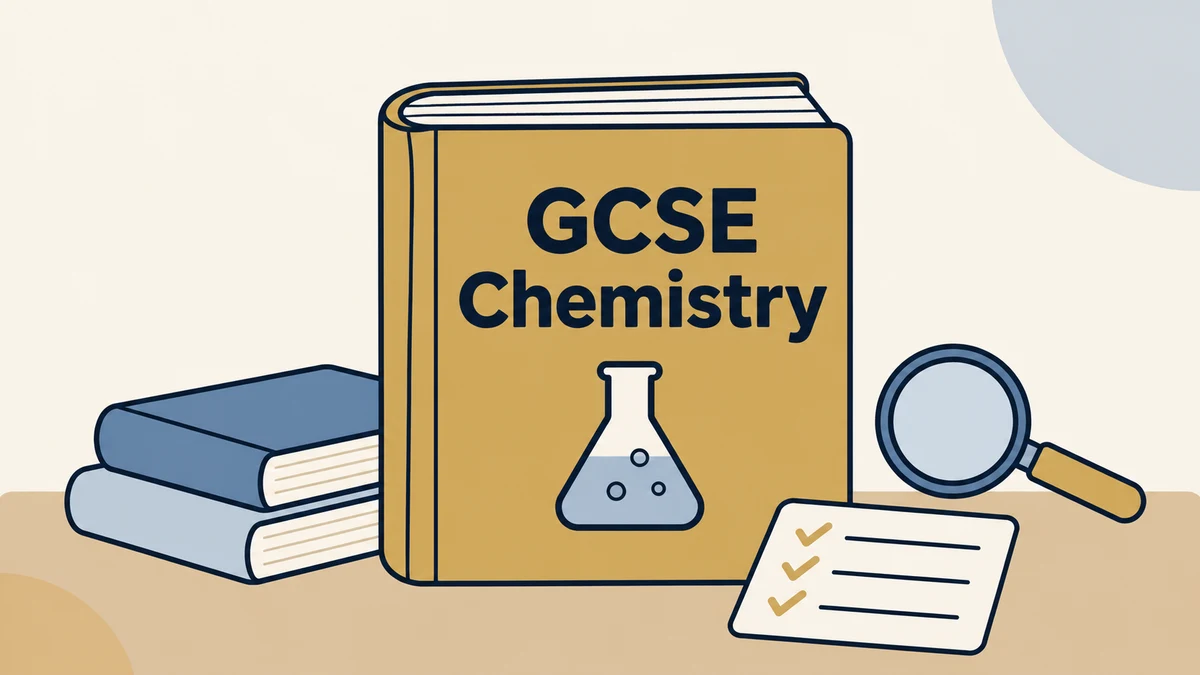
A Chemistry textbook or revision guide is only useful if it matches the course the school is actually teaching. UK GCSE science is offered by more than one exam board, as Combined Science or as separate sciences, and at Foundation or Higher Tier. Buying a well-known book first, and checking those details later, is a common way to end up with the wrong papers, the wrong topic list, or a guide written for a different qualification.
This article is a checking sequence, not a publisher ranking. It covers UK GCSE only. International GCSE is a different qualification, and a book written for it should not be used as if it were the school’s UK GCSE course.
Confirm the qualification before opening a shop listing
Ask the school, in writing if possible, for four facts:
- the awarding organisation (the exam board);
- the exact qualification title and specification code;
- whether the entry is Combined Science or separate Chemistry (often called “Triple Science” informally);
- whether the planned entry is Foundation or Higher Tier.
Those four details should be taken from the school, not inferred from a sibling’s book, a friend’s school, or the title on a popular revision guide.
The main UK GCSE Chemistry-related routes, and the official codes, are:
- AQA GCSE Chemistry (8462) and AQA Combined Science: Trilogy (8464). AQA also refers to Combined Science: Synergy, so the school should confirm which Combined qualification, if any, is taught.[1][2]
- OCR Chemistry A (Gateway, J248) and Combined Science A (Gateway, J250), or OCR Chemistry B (Twenty First Century, J258) and Combined Science B (Twenty First Century, J260). The two OCR suites are not interchangeable.[3][4][12][13]
- Pearson Edexcel GCSE Chemistry (1CH0) and Pearson Edexcel Combined Science (1SC0).[5][6]
- WJEC Eduqas GCSE (9-1) in Chemistry, Qualification Accreditation Number 601/8640/9, assessed at Foundation or Higher Tier, with both components taken at the same tier in the same series. This article mentions Eduqas for identification only. The specification states that this Ofqual-regulated qualification is not available for candidates in maintained schools and colleges in Wales.[7]
“Triple Science” is a common way of describing three separate GCSEs in Biology, Chemistry and Physics. Combined Science is a single qualification covering all three sciences and awarded as a double grade. The papers, timing, practical requirements and chemistry-only content differ by qualification, which is why a Combined Science Chemistry book is not a substitute for a separate Chemistry book, even when both mention Higher Tier. For a parent-facing comparison of those routes, see the discussion of exam boards in why there are so many GCSE and A-level exam boards. For AQA tier grade ranges in more detail, see the Foundation or Higher Tier guide; that article should not be used as evidence for OCR, Pearson or Eduqas rules.
Match the book to those four facts
Once the school has confirmed the course, check the cover, title page and any specification code printed in the book against that information. A title that only says “GCSE Chemistry” or “9-1 Science” is not specific enough. The board name, the qualification title (Chemistry or Combined Science) and, where the book is tiered, Foundation or Higher should all be visible.
If the school uses OCR, the suite matters as well as the board: a Gateway (J248 or J250) book does not match Twenty First Century Science (J258 or J260). If the school uses AQA Combined Science, Trilogy (8464) and Synergy should not be treated as the same course.[1][2][3][4]
Tier needs the same care. Foundation and Higher papers are different assessments, with different grade ranges. Some books are written for one tier; others include Higher material and mark it clearly. A Foundation-only guide will not cover the additional Higher content, and a Higher book may include material that is not assessed on the Foundation papers. The school should confirm the planned tier before a tier-specific book is bought.
Practice papers and mark schemes should be matched in the same way. A Combined Science Chemistry paper is not a timed rehearsal for separate Chemistry, and a paper from another board is not a substitute for the papers the student will sit.
What “approved” or “endorsed” means — and does not mean
Some boards publish lists of approved or endorsed textbooks and other resources. AQA states that an “AQA approved” textbook has been checked by its subject experts as providing good support for its specifications; books that do not carry that badge have not been through the approval process and do not provide the same reassurance, even if the AQA name appears in the title. AQA also states that purchase of those books is not essential to deliver the specifications.[8]
OCR publishes “Textbooks & endorsed resources” pages for individual qualifications, including Gateway Chemistry A (J248) and Gateway Combined Science A (J250), and identifies resources that have been endorsed for a named specification.[9][10] Endorsement or approval is therefore a check against a particular specification. It is not a requirement to buy that book, and it is not a ranking of publishers.
A book can still be useful without an approval badge if it matches the confirmed qualification and tier, but the school or the official specification remains the reference point. A revision guide can support preparation; it does not replace the practical work the specification requires students to carry out.
If the school does not issue a textbook and works from booklets or notes, that is a separate situation, discussed in when there is no Chemistry textbook. The checking sequence above still applies to any revision guide bought at home.
Keep International GCSE separate
Pearson Edexcel, among other organisations, also offers International GCSE Chemistry, which is a different qualification from Pearson Edexcel GCSE Chemistry (1CH0).[5][11] An International GCSE book, past paper or topic list should not be used as if it were the UK GCSE course, even when both use a 9-1 grade scale and both have Chemistry in the title. If a student is entered for International GCSE, that is the qualification whose official specification and papers should be used; the UK GCSE codes in this article do not apply to it.
Confirm the current official specification for the student’s examination series before relying on any printed resource, because documents and endorsed lists are updated.
Where to go next
Confirm the exam board, qualification code, Combined or separate sciences, and Foundation or Higher Tier with the school before buying a Chemistry textbook or revision guide.
Free AQA A-level Chemistry Guide (in English): a clear overview of the A-level course. Get the free guide
1-to-1 Chemistry tuition with Teacher Tommy: personal feedback for your child. Tuition enquiry
Prefer to message? WhatsApp Tommy
Neither the guide nor tuition can predict or promise a grade.
Sources
- AQA, GCSE Combined Science: Trilogy (8464) Specification, Version 1.3, October 2026 (accessed 10 Nov 2026, HKT).
- AQA, GCSE Chemistry (8462) Specification, Version 1.2, 16 January 2026 (accessed 10 Nov 2026, HKT).
- OCR, GCSE Chemistry A (Gateway Science) J248 Specification (accessed 10 Nov 2026, HKT).
- OCR, GCSE Combined Science A (Gateway Science) J250 Specification (accessed 10 Nov 2026, HKT).
- Pearson, Edexcel GCSE (9–1) Chemistry (1CH0) Specification, Issue 4, March 2024 (accessed 10 Nov 2026, HKT).
- Pearson, Edexcel GCSE (9–1) Combined Science (1SC0) Specification, Issue 6, March 2024 (accessed 10 Nov 2026, HKT).
- WJEC Eduqas, GCSE (9-1) in Chemistry Specification, Version 3, January 2019 — Qualification Accreditation Number 601/8640/9; Foundation or Higher Tier, both components in the same series; not available for candidates in maintained schools and colleges in Wales (accessed 10 Nov 2026, HKT).
- AQA, Approved textbooks — “AQA approved” means subject experts have checked that the book provides good support for the specifications; purchase is not essential to deliver the specifications; the AQA name in a title is not the same as approval (accessed 10 Nov 2026, HKT).
- OCR, Gateway Science Suite — Chemistry A (9-1) — J248: Textbooks & endorsed resources (accessed 10 Nov 2026, HKT).
- OCR, Gateway Science Suite — Combined Science A (9-1) — J250: Textbooks & endorsed resources (accessed 10 Nov 2026, HKT).
- Pearson, Edexcel International GCSE Chemistry (2017) — a different qualification from Pearson Edexcel GCSE Chemistry (1CH0) (accessed 10 Nov 2026, HKT).
- OCR, GCSE Chemistry B (Twenty First Century Science) J258 Specification (accessed 10 Nov 2026, HKT).
- OCR, GCSE Combined Science B (Twenty First Century Science) J260 Specification (accessed 10 Nov 2026, HKT).