
For parents
Combined Science or Separate Sciences at GCSE: What Parents Should Know
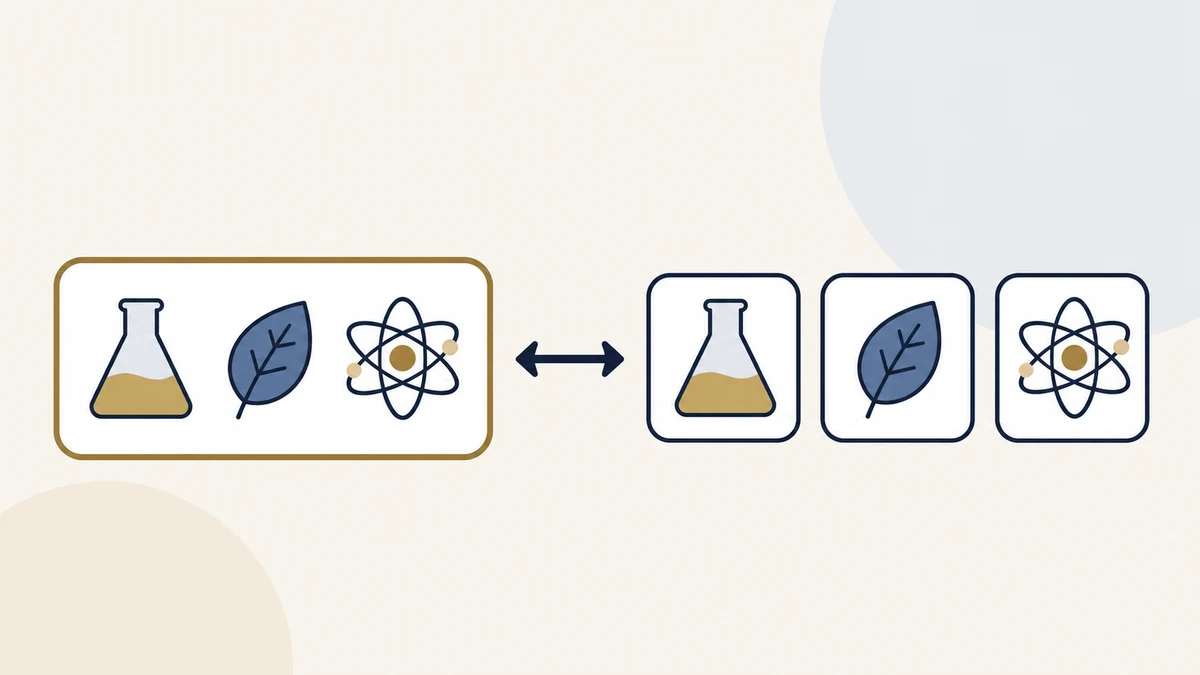
Families often hear “Combined Science” and “Triple Science” used as if they were two versions of the same course. In England they are different GCSE arrangements, with different qualification titles, paper structures and practical requirements. This article explains what those differences are on the current UK GCSE specifications from AQA, OCR and Pearson Edexcel, so that revision materials and later decisions can be matched to the course the school is actually teaching.
It covers UK GCSE only. International GCSE is a different qualification, and the codes and rules below should not be applied to it. The aim is identification, not a ranking of routes.
Start with the qualification, not the nickname
“Triple Science” is a common way of describing three separate GCSEs: Biology, Chemistry and Physics. Combined Science is a single qualification covering all three sciences and awarded as a double grade, such as 6–6 or 7–6, rather than as a separate Chemistry GCSE.[1][4][6][8]
Ask the school for the awarding organisation, the exact qualification title and the specification code, and whether the planned entry is Foundation or Higher Tier. If the school uses OCR, also ask whether the route is Gateway Science or Twenty First Century Science: OCR offers Combined Science and separate Chemistry in both suites, and the paper layouts are not interchangeable.[3][4][5][6] AQA’s Combined Science course discussed here is Combined Science: Trilogy (8464); its Chemistry specification also refers to Combined Science: Synergy, so the school should confirm which Combined qualification, if any, is taught.[1][2]
For background on why more than one board exists, see why there are so many GCSE and A-level exam boards. For AQA tier grade ranges in more detail, see the Foundation or Higher Tier guide; that article should not be used as evidence for OCR or Pearson rules.
What the papers look like
The number of papers a student sits depends on the qualification, not on the informal label “science”. The table below summarises the UK GCSE Chemistry-related routes discussed in this article. It is for identification only.
| Qualification | Code(s) | Number of papers | Paper length and marks | Tiers and grade range | Required practicals / PAGs |
|---|---|---|---|---|---|
| AQA GCSE Chemistry (separate) | 8462[2] | 2 at one tier | Each 1 hour 45 minutes, 100 marks | Foundation 1–5; Higher 4–9, allowed grade 3 | 8 required practicals |
| AQA Combined Science: Trilogy | 8464[1] | 6 at one tier | Each 1 hour 15 minutes, 70 marks | Foundation 1–1 to 5–5; Higher 4–4 to 9–9, allowed grade 4–3 | 21 required practicals |
| OCR Chemistry A (Gateway) | J248[3] | 2 at one tier | Each 1 hour 45 minutes, 90 marks | Foundation 1–5; Higher 4–9, allowed grade 3 | 8 PAGs |
| OCR Chemistry B (Twenty First Century) | J258[5] | 2 at one tier | Each 1 hour 45 minutes, 90 marks | Foundation 1–5; Higher 4–9, allowed grade 3 | 8 PAGs |
| OCR Combined Science A (Gateway) | J250[4] | 6 at one tier | Each 1 hour 10 minutes, 60 marks | Foundation 1–1 to 5–5; Higher 4–4 to 9–9, allowed grade 4–3 | 16 PAGs |
| OCR Combined Science B (Twenty First Century) | J260[6] | 4 at one tier | All 1 hour 45 minutes; Biology, Chemistry and Physics papers 95 marks each; Combined Science paper 75 marks | Foundation 1–1 to 5–5; Higher 4–4 to 9–9, allowed grade 4–3 | 16 PAGs |
| Pearson Edexcel GCSE Chemistry (separate) | 1CH0[7] | 2 at one tier | Each 1 hour 45 minutes, 100 marks | Foundation 1–5; Higher 4–9, allowed grade 3 | 8 mandatory core practicals |
| Pearson Edexcel Combined Science | 1SC0[8] | 6 at one tier | Each 1 hour 10 minutes, 60 marks | Foundation 1–1 to 5–5; Higher 4–4 to 9–9, allowed grade 4–3 | 18 mandatory core practicals |
Table notes. Number of papers is the number a candidate sits at the selected tier, not the full Foundation-plus-Higher paper menu. An allowed grade is awarded only under the conditions in the relevant specification, typically when a Higher Tier candidate is a small number of marks below the grade 4 or 4–4 boundary; it is not an automatic fallback. Combined Science practical and PAG totals are across Biology, Chemistry and Physics, not Chemistry alone; the OCR Combined total of 16 PAGs comprises five biology, five chemistry and six physics. AQA Combined Science: Synergy is a different Combined qualification, referred to in the Chemistry specification, and is not tabulated here. Sources are the official specifications listed as [1]–[8].
The same assessment details are set out in the paragraphs that follow.
AQA Combined Science: Trilogy (8464) has six written papers at one tier, two each for Biology, Chemistry and Physics. Each lasts 1 hour 15 minutes, carries 70 marks and contributes 16.7% of the qualification. The qualification is graded on a 17-point scale from 1–1 to 9–9. Foundation covers 1–1 to 5–5; Higher covers 4–4 to 9–9, with an allowed grade 4–3 for a student who just fails to achieve 4–4.[1]
AQA GCSE Chemistry (8462), taken as a separate science, has two papers, each 1 hour 45 minutes, 100 marks and 50% of the qualification. Foundation covers grades 1 to 5; Higher covers 4 to 9, with an allowed grade 3 for a student who just fails to achieve grade 4.[2]
OCR Combined Science A (Gateway, J250) also uses six papers at one tier, each 1 hour 10 minutes and 60 marks. The specification states that this qualification is worth two GCSEs. OCR Combined Science B (Twenty First Century, J260) is also worth two GCSEs, but the paper structure is different: a candidate is entered for four papers at one tier, all 1 hour 45 minutes, including a Combined Science paper that assesses content from across all teaching chapters. OCR Chemistry A (J248) and Chemistry B (J258) each have two papers at the selected tier, of 1 hour 45 minutes and 90 marks.[3][4][5][6]
Pearson Edexcel Combined Science (1SC0) has six papers, each 1 hour 10 minutes, 60 marks and 16.67%. Pearson Edexcel Chemistry (1CH0) has two papers, each 1 hour 45 minutes, 100 marks and 50%. In both qualifications, all assessments must be completed at the same tier and in May/June of a single year.[7][8]
A Combined Science Chemistry paper is therefore not a substitute timed practice paper for separate Chemistry, even when both mention Chemistry and Higher Tier.
Content and practical work
Separate Chemistry includes additional material. In the AQA Chemistry specification, content that appears only there is marked “chemistry only”. Most of the chemistry content is co-teachable with Combined Science: Trilogy, but the shared topic titles do not make the coverage identical. Examples of chemistry-only areas include titrations, yields and atom economy, and specified later organic and materials content.[2]
Practical requirements also differ by qualification. AQA Chemistry specifies eight required practicals, of which two are chemistry only; Combined Science: Trilogy specifies 21 required practicals across Biology, Chemistry and Physics.[1][2] Pearson’s Practical work section requires eight mandatory core practicals for Chemistry (1CH0) and eighteen across the three sciences for Combined Science (1SC0), not eighteen Chemistry practicals.[7][8] OCR organises practical requirements into Practical Activity Groups, with eight for separate Chemistry and sixteen for Combined Science; centres have flexibility over activities, but participation and coverage requirements remain, and practical skills are assessed in the written papers.[3][4][5][6]
A revision guide or video can support preparation. It does not replace the practical work the specification requires students to carry out.
Questions worth asking the school
Entry to Combined Science or to the separate sciences is organised by the school, including how the timetable and option blocks work. The specifications do not prescribe a single “correct” choice for every student.
Useful questions include:
- Which qualification codes will be entered, and at which tier?
- If the school offers both routes, how is teaching time arranged, and when must a decision be made?
- What does the sixth form or college usually expect for A-level science, and is that a school rule rather than a national rule?
- Which past papers and mark schemes match the planned entry?
A later A-level science application is a reason to ask those questions early. It is not, on its own, evidence that Combined Science is unsuitable, or that separate sciences are required. Sixth-form entry rules vary and should be checked with the school that will teach the A-level course.
Match any practice paper to the confirmed qualification and tier before treating it as a timed rehearsal. Confirm the current official specification for the student’s examination series, because documents are updated.
Where to go next
Knowing whether your child is entered for Combined Science or the separate sciences makes it possible to match papers, practical requirements and later questions to the right course.
1-to-1 Chemistry tuition with Teacher Tommy: personal feedback for your child. Tuition enquiry
Prefer to message? WhatsApp Tommy
Tuition cannot predict or promise a grade.
Sources
- AQA, GCSE Combined Science: Trilogy (8464) Specification, Version 1.3, October 2026 — specification at a glance; 21 required practicals; awarding on the 17-point scale 1–1 to 9–9 (accessed 10 Nov 2026, HKT).
- AQA, GCSE Chemistry (8462) Specification, Version 1.2, 16 January 2026 — assessment overview; chemistry-only content; eight required practicals; awarding 1–5 / 4–9 with allowed grade 3 (accessed 10 Nov 2026, HKT).
- OCR, GCSE Chemistry A (Gateway Science) J248 Specification, Version 4.0, August 2026 (accessed 10 Nov 2026, HKT).
- OCR, GCSE Combined Science A (Gateway Science) J250 Specification, Version 5.0, May 2026 — six-paper assessment; “worth two GCSEs” (accessed 10 Nov 2026, HKT).
- OCR, GCSE Chemistry B (Twenty First Century Science) J258 Specification, Version 4.0, August 2026 (accessed 10 Nov 2026, HKT).
- OCR, GCSE Combined Science B (Twenty First Century Science) J260 Specification, Version 5.0, June 2026 — four-paper assessment; “worth two GCSEs” (accessed 10 Nov 2026, HKT).
- Pearson, Edexcel GCSE (9–1) Chemistry (1CH0) Specification, Issue 4, March 2024 — Qualification at a glance; Practical work, eight mandatory core practicals (accessed 10 Nov 2026, HKT).
- Pearson, Edexcel GCSE (9–1) Combined Science (1SC0) Specification, Issue 6, March 2024 — six papers; Practical work, 18 mandatory core practicals across the sciences (accessed 10 Nov 2026, HKT).