
For students
Why Re-reading Chemistry Notes Is Not Enough: A 4-Week A-level Revision Plan
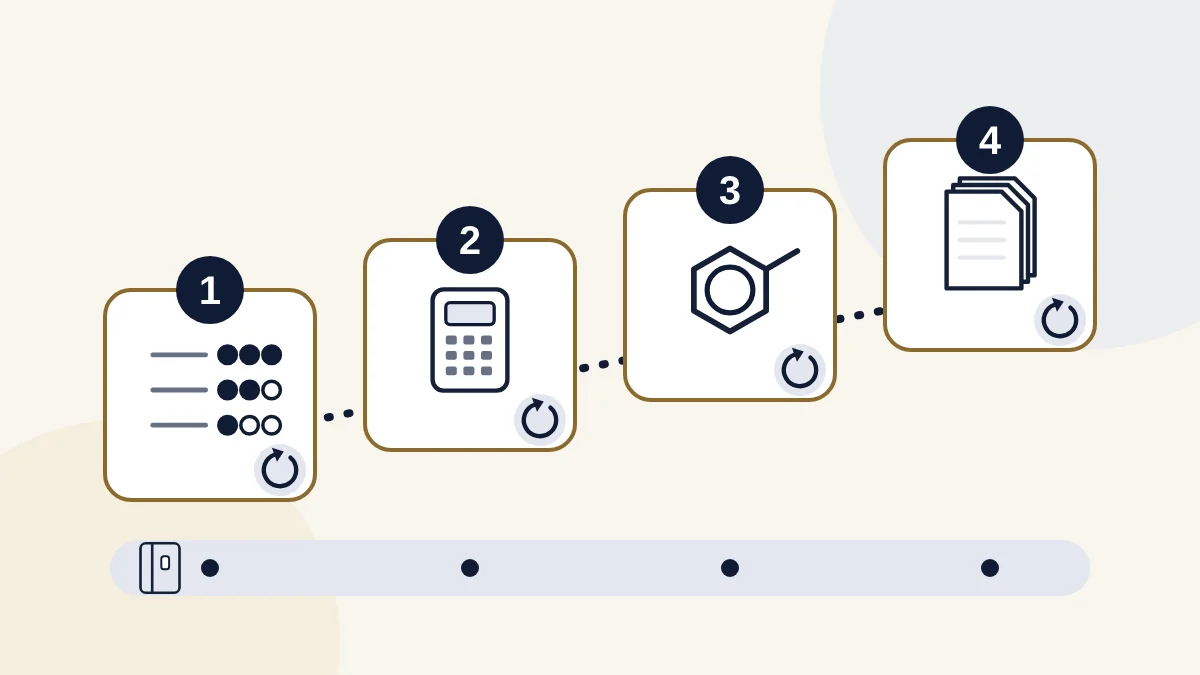
Re-reading feels productive. The pages become familiar, the highlighted lines look complete, and an evening spent with your notes seems like an evening well spent. The difficulty is that an exam does not ask you to recognise your notes. It asks you to produce an answer, often to a question worded in a way you have not seen before.
What the research says about re-reading and highlighting
In a widely cited review, Dunlosky and colleagues (2013) evaluated ten common study techniques. They rated highlighting and re-reading as having low utility: not useless, but offering little benefit for the time they take, compared with alternatives. Two techniques received their highest rating, practice testing and distributed practice.
The likely problem is that familiarity is easy to mistake for knowledge. Recognising a mechanism on the page is far easier than drawing it from memory, so re-reading can leave you feeling more prepared than you are.
Retrieval and spacing, in plain terms
Retrieval practice means pulling information out of memory rather than putting it back in: closing the book and writing, answering questions, or explaining an idea aloud. In one well-known experiment, Roediger and Karpicke (2006) found that students who practised recalling a prose passage remembered more of it a week later than students who re-read it, even though re-reading gave slightly better results on a test taken five minutes afterwards.
Spaced practice means returning to material across days and weeks rather than in one block. A large review by Cepeda and colleagues (2006) found that spacing study sessions generally improved long-term retention compared with massing them together, mainly in verbal-recall studies.
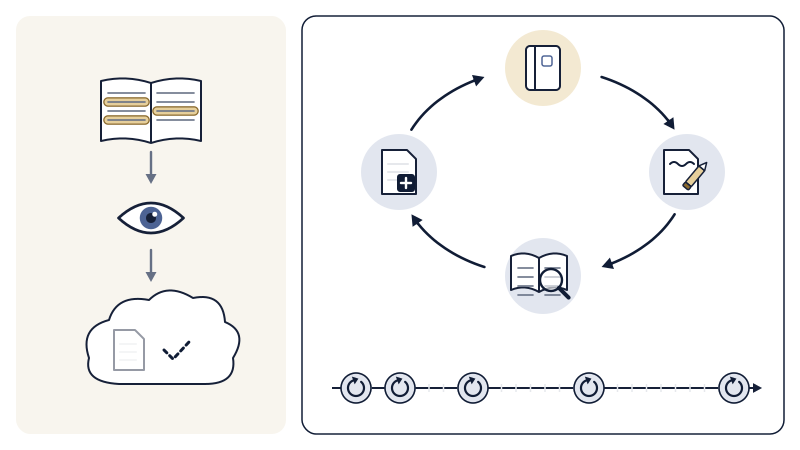
The Education Endowment Foundation's guidance on metacognition adds a third idea: effective learners plan, monitor and evaluate their own learning. The error log described below is one practical way to do that.
What active recall looks like in Chemistry
- From a blank page, draw the mechanism for nucleophilic substitution of a haloalkane by hydroxide ions, then check every curly arrow and lone pair.
- Write definitions such as standard enthalpy of formation from memory, then compare them with mark scheme wording.
- Redo a Kc or buffer pH calculation you got wrong last week, without looking at the solution.
- Explain aloud why water has a higher boiling point than hydrogen sulfide, then check that you mentioned the relevant intermolecular forces.
- Use flashcards for organic reagents and conditions, sorting them into "secure" and "not yet".
Using past papers without memorising answers
Exam boards publish past papers, mark schemes and examiner reports; your school may also have access to recent papers that are not yet public. Attempt papers closed-book and timed, then mark honestly. For every lost mark, ask which principle the marking point rewards. Examiner reports describe where students commonly lose marks across the whole cohort, which may point to where you lose them too.
Memorising model answers is risky because questions are rarely repeated word for word. Learn why an answer earns the mark, and practise applying that reason to a different compound or set of data.
Keeping an error log
For every question you get wrong, record the topic, what went wrong and how you will fix it, and classify the error:
| Type | Example |
|---|---|
| Knowledge | Forgot the conditions for a reaction or a definition |
| Calculation | Did not convert cm³ to dm³, used the wrong mole ratio |
| Reasoning | Knew the facts but could not link them to explain an observation |
| Exam technique | Ignored the command word, gave too few points for the marks, ran out of time |
Each type needs a different remedy: flashcards for knowledge, problems attempted independently, checked and revisited for calculations, explaining answers aloud for reasoning, and timed practice for technique. Re-test each logged question a few days later.
The four-week plan
The research supports the principles above. This specific schedule is a suggested way of applying them; it has not itself been tested in a study and cannot guarantee a particular result. As an illustration, it assumes roughly six to eight hours of Chemistry revision a week; adjust this around your other subjects and school commitments.
Week 1: Audit and foundations. Go through your exam board's specification content and rate each section as secure, partly secure or weak. Do short topic questions to check your ratings. Start the error log. Prioritise foundations later topics rely on: amount of substance, bonding and energetics, plus maths skills such as rearranging equations and logarithms.
Week 2: Physical and inorganic chemistry. Mix calculation practice with retrieval of definitions and trends. Revisit Week 1 errors. Review the practicals linked to these topics: apparatus, method, sources of error and how data is processed.
Week 3: Organic chemistry, practical skills and data. Practise mechanisms and synthesis routes from memory. Work through questions on practical techniques and data analysis, including uncertainties and graphs, as on AQA's or Edexcel's Paper 3 (OCR spreads them across its written papers). Seek out questions set in unfamiliar contexts.
Week 4: Full papers and targeted repair. Sit at least one full paper under timed conditions (in Year 12, only once the relevant content has been taught), mark it and read the matching examiner report. Spend the remaining time on your error log, re-testing earlier mistakes. Keep the final day or two lighter.

Checking progress and adapting the plan
Judge progress by evidence, not by how familiar the notes feel: the proportion of logged errors you now get right, your accuracy on unseen questions, and your timed paper marks, remembering that a single paper is a noisy measure.
Adapt the plan to your starting point. If Week 1 shows weak foundations, extend it before moving on. If your foundations are secure, add extra full papers and unfamiliar-context questions. Year 12 students preparing for mocks should restrict the plan to content they have been taught.
Where to go next
Build your Chemistry revision around recall, spaced practice and revisiting errors, rather than familiarity with your notes.
Free AQA A-level Chemistry Guide (in English): a clear overview of the AQA A-level course. Get the free guide
1-to-1 Chemistry tuition with Teacher Tommy: personal feedback on your answers. Tuition enquiry
Prefer to message? WhatsApp Tommy
References
- Dunlosky, J., Rawson, K. A., Marsh, E. J., Nathan, M. J. and Willingham, D. T. (2013). Improving students' learning with effective learning techniques. Psychological Science in the Public Interest, 14(1), 4–58. DOI 10.1177/1529100612453266 (publisher page; may require subscription; accessed 22 Oct 2026)
- Roediger, H. L. and Karpicke, J. D. (2006). Test-enhanced learning: Taking memory tests improves long-term retention. Psychological Science, 17(3), 249–255. DOI 10.1111/j.1467-9280.2006.01693.x (publisher page; may require subscription; accessed 22 Oct 2026)
- Cepeda, N. J., Pashler, H., Vul, E., Wixted, J. T. and Rohrer, D. (2006). Distributed practice in verbal recall tasks: A review and quantitative synthesis. Psychological Bulletin, 132(3), 354–380. DOI 10.1037/0033-2909.132.3.354 (publisher page; may require subscription; accessed 22 Oct 2026)
- Education Endowment Foundation. Metacognition and Self-Regulated Learning guidance report. EEF metacognition guidance (accessed 22 Oct 2026)
- AQA (2015). AS and A-level Chemistry (7404/7405) Specification, including the assessment overview, the 12 required practical activities and the mathematical requirements. AQA A-level Chemistry 7405 specification PDF (accessed 22 Oct 2026)
- AQA. A-level Chemistry 7405 assessment resources. AQA 7405 assessment resources (accessed 22 Oct 2026)
- Cambridge OCR (2026). A Level Chemistry A (H432) Specification, version 3.1, assessment overview and Section 1.1 (practical skills assessed in written examinations). OCR A Level Chemistry A H432 specification PDF (accessed 22 Oct 2026)
- Pearson (2024). Pearson Edexcel Level 3 Advanced GCE in Chemistry (9CH0) Specification, Issue 3, Paper 3 (General and Practical Principles in Chemistry) overview. Pearson Edexcel A level Chemistry 9CH0 specification PDF (accessed 22 Oct 2026)
- Cambridge OCR. Past paper schedule. OCR past paper schedule (accessed 22 Oct 2026)
- Pearson. Past papers. Pearson qualifications past papers (accessed 22 Oct 2026)