
For students
Buffer Solutions Explained: Why the pH Barely Moves
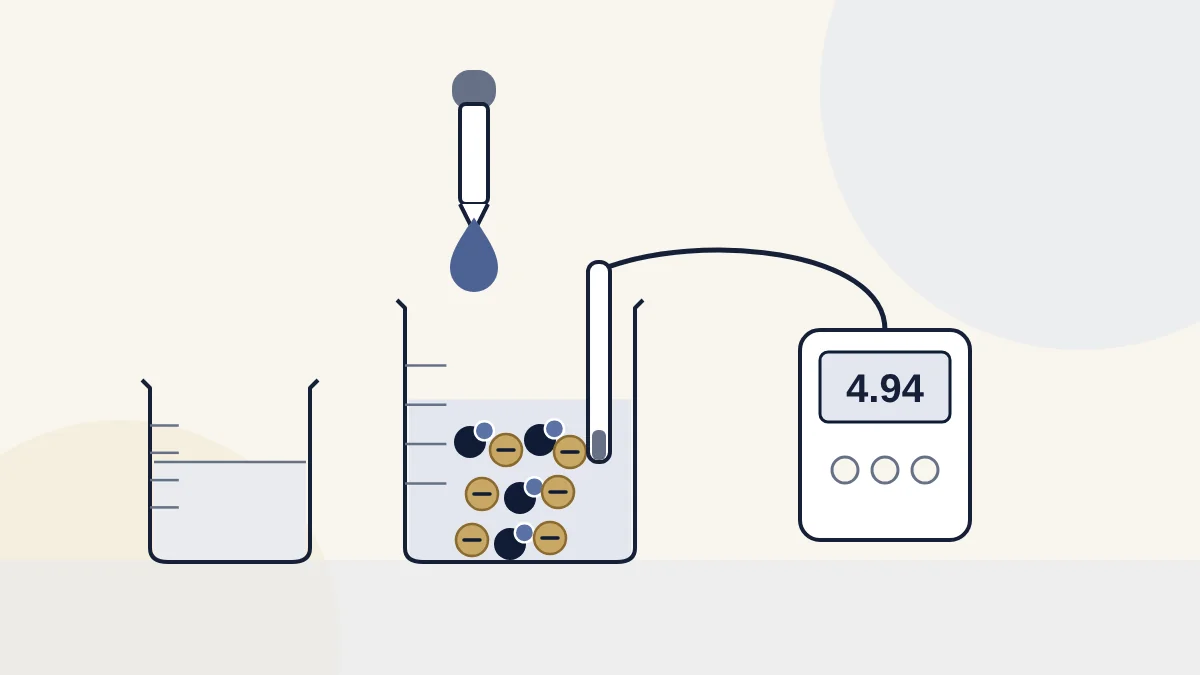
Add 0.0100 mol of hydrochloric acid to 1.00 dm3 of pure water at 298 K (ignoring the small change in volume) and the pH falls from 7.00 to 2.00. Add the same amount to 1.00 dm3 of the ethanoic acid–sodium ethanoate buffer in the worked example below (0.100 mol ethanoic acid, 0.150 mol sodium ethanoate) and the pH falls by less than a tenth of a unit. Here is why, and how to handle the calculations in AQA section 3.1.12.6.
What "approximately constant" actually means
AQA's specification says a buffer maintains an approximately constant pH despite dilution or the addition of small amounts of acid or base. Both qualifications matter.
The pH does change, just far less than in water. And a buffer has a finite capacity: it relies on large reserves of two species that remove added H+ or OH−, and if the amount added approaches either reserve, that species runs out and the pH changes sharply.
What is in an acidic buffer
An acidic buffer contains a weak acid, HA, and its conjugate base, A−, usually supplied as a salt such as sodium ethanoate:
Both HA and A− are present in substantial amounts. The fully dissociated salt supplies plenty of A−, while the weak acid is only slightly dissociated, and the A− already present suppresses that dissociation further, so almost all of it stays as HA. AQA also expects you to explain basic buffers, such as ammonia with ammonium chloride, qualitatively; pH calculations are only required for acidic buffers. OCR (Chemistry A, H432, and Chemistry B, H433) and Pearson Edexcel (9CH0) A-level specifications also cover buffer action and buffer pH calculations, but do not mention basic buffers explicitly; OCR A and Edexcel also include the carbonic acid–hydrogencarbonate buffer in blood.
Adding a small amount of acid
Added H+ ions react with the conjugate base:
The equilibrium shifts to the left. Most of the added H+ is removed; A− falls slightly and HA rises slightly.
Adding a small amount of alkali
Added OH− ions react with the weak acid:
Equivalently, OH− removes H+ as water and more HA dissociates to replace it, shifting the equilibrium to the right. Either way, HA falls slightly and A− rises slightly.

Why the ratio of HA to A− controls the pH
At equilibrium, the acid dissociation constant gives a relationship that is exact within the ideal-solution model used at A-level:
At fixed temperature Ka is constant, so [H+] depends on the ratio [HA]/[A−]. When both are present in sufficient amounts compared with the acid or alkali added, a small addition barely changes the ratio, so [H+] barely changes. Dilution lowers both concentrations by the same factor, leaving the ratio, and therefore the pH, approximately unchanged.
Worked example
A buffer contains 0.100 mol of ethanoic acid and 0.150 mol of sodium ethanoate in 1.00 dm3 of solution at 298 K. Ka for ethanoic acid = 1.74 × 10⁻⁵ mol dm−3 (the value used for this example, commonly tabulated near 298 K; in an exam, use the value given in the question). Calculate the pH.
Assumptions (approximations):
- [HA] at equilibrium ≈ 0.100 mol dm−3, because very little of the acid dissociates.
- [A−] at equilibrium ≈ 0.150 mol dm−3, all from the salt; the contribution from the acid's dissociation is negligible.
pH = −log₁₀(1.16 × 10⁻⁵) = 4.94
pH has no units; two decimal places suits data given to three significant figures. The assumptions hold, since 1.16 × 10⁻⁵ mol dm−3 is tiny compared with 0.100 mol dm−3.
Now add 0.0100 mol of HCl, assuming the volume change is negligible. The H+ converts 0.0100 mol of A− into HA, giving 0.110 mol HA and 0.140 mol A−:
The pH has fallen by about 0.07, compared with a fall of five units in water.
When neutralisation must come first
Many exam buffers are made by partially neutralising a weak acid with a strong base such as NaOH, so the starting amounts cannot be used directly. Calculate the moles of each reactant, react all the OH− with HA (essentially to completion), and find the moles of HA remaining and A− formed. Only then apply the Ka expression. HA and A− share one volume, so a ratio of moles equals the ratio of concentrations.
If the OH− is equal to or greater than the HA, no weak acid remains, so the solution is not a buffer and the method does not apply. A useful special case: when exactly half the acid has been neutralised, [HA] = [A−], so [H+] = Ka and pH = pKa.

Common mistakes
- Using the weak-acid method. [H+] = √(Ka[HA]) assumes [H+] = [A−], which is false in a buffer, where A− comes mainly from the salt.
- Skipping the neutralisation step, and using the original moles of acid after NaOH has been added.
- Overstating buffer action, for example writing that the pH "does not change" or that the buffer "removes all added acid".
- Mixing moles and concentrations in one ratio, or rounding too early.
A real application
Blood plasma is kept at about pH 7.35–7.45, partly by a carbonic acid–hydrogencarbonate buffer.
Original AQA-style practice question
20.0 cm3 of 0.100 mol dm−3 NaOH is added to 50.0 cm3 of 0.100 mol dm−3 ethanoic acid at 298 K. Ka = 1.74 × 10⁻⁵ mol dm−3. Calculate the pH of the resulting solution. Give your answer to two decimal places. [4 marks]
Worked answer
n(CH₃COOH) = 0.0500 dm3 × 0.100 mol dm−3 = 5.00 × 10⁻³ mol; n(OH−) = 0.0200 × 0.100 = 2.00 × 10⁻³ mol
Remaining CH₃COOH = 3.00 × 10⁻³ mol; CH₃COO− formed = 2.00 × 10⁻³ mol
(The 70.0 cm3 total volume cancels.)
pH = 4.58
Indicative marks (not an official AQA scheme): initial moles; moles after neutralisation; [H+]; pH.
Where to go next
For buffer calculations, understand how the acid–base ratio controls pH and account for neutralisation before using the equilibrium expression.
Free AQA A-level Chemistry Guide (in English): a clear overview of the AQA A-level course. Get the free guide
1-to-1 Chemistry tuition with Teacher Tommy: personal feedback on your answers. Tuition enquiry
Prefer to message? WhatsApp Tommy
References
- AQA (2015). AS and A-level Chemistry (7404/7405) Specification, section 3.1.12.6 Buffer action (A-level only), and sections 3.1.12.1–3.1.12.5 on acids, pH, Kw, Ka and pH curves. AQA A-level Chemistry 7405 specification PDF (accessed 22 Oct 2026)
- LibreTexts Chemistry. Buffers (Supplemental Modules: Acids and Bases). LibreTexts: Buffers (accessed 22 Oct 2026)
- LibreTexts Chemistry. Blood as a Buffer. LibreTexts: Blood as a Buffer (accessed 22 Oct 2026)
- AQA. A-level Chemistry 7405 assessment resources (past papers, mark schemes, examiner reports). AQA 7405 assessment resources (accessed 22 Oct 2026)
- Cambridge OCR (2026). A Level Chemistry A (H432) Specification, version 3.1, section 5.1.3 (Acids, bases and buffers), learning outcomes (i)–(m) on buffers. OCR A Level Chemistry A H432 specification PDF (accessed 22 Oct 2026)
- Cambridge OCR (2026). A Level Chemistry B (Salters) (H433) Specification, version 4.1, Oceans (O) learning outcome (m), buffer solutions. OCR A Level Chemistry B (Salters) H433 specification PDF (accessed 22 Oct 2026)
- Pearson (2024). Pearson Edexcel Level 3 Advanced GCE in Chemistry (9CH0) Specification, Issue 3, Topic 12 (Acid-base Equilibria), points 18–22 and 24. Pearson Edexcel A level Chemistry 9CH0 specification PDF (accessed 22 Oct 2026)